If you're a U.S. citizen in love with someone in Vietnam, the K-1 fiancé visa is usually the first path you hear about. This guide walks you through the entire K-1 process in 2026: who qualifies, what it costs, how long it takes and the income requirement.
Who qualifies for a K-1 visa?
You qualify if all of these are true:
- You are a U.S. citizen. Green-card holders cannot petition a K-1 — they must use the spousal route instead.
- You are legally free to marry. Any prior marriage must be legally ended (divorce, annulment, or death of spouse).
- You and your fiancée have met in person within the last two years. USCIS grants a rare waiver only if meeting would violate strict, long-established cultural traditions, or cause extreme hardship. Purely online relationships still face hard cases at the consular post.
- You both intend to marry within 90 days of her arrival in the U.S. Not a vague plan — a real wedding.
- You meet the income requirement when the case reaches the consular stage (see below).
The K-1 process
- Form I-129F — filed by you, the U.S. citizen, with USCIS. This is where you prove the relationship is genuine.
- USCIS decision — when approved, the file is forwarded to the U.S. Department of State's National Visa Center (NVC).
- Packet 3-K (PKT3-K) and DS-160 — once the NVC is finished, your fiancée's case is sent to the U.S. Consulate General in Ho Chi Minh City.
- Medical exam in Vietnam — at one of the panel physicians designated by the Consulate in HCMC.
- Interview at the U.S. Consulate General in Ho Chi Minh City — The consular officer decides whether to issue the K-1 visa.
- Entry to the U.S. — the K-1 holder enters and must marry within 90 days.
- Marriage + Form I-485 (Adjustment of Status) — after the wedding, the K-1 holder files I-485 to become a lawful permanent resident, accompanied by Form I-864 from you, the sponsor.
How much does it cost in 2026?
Fees are set by the 2024 USCIS Final Rule and remain in effect going into 2026, always confirm current amounts before filing. As of my latest check (October 2026):
- Form I-129F: $675
- K-1 visa application fee: $265
- Medical exam in HCMC: roughly $500
- Adjustment of Status fee: $1,440
- Work Permit (optional): $260
- Advance Parole (optional): $630
Verify all amounts against the current USCIS G-1055 fee schedule and the State Department's fee page.
The 2026 income requirement for K-1 visa
- Form I-134 is filed at the consular stage, asking you to show household income at 100% of the 2026 HHS Poverty Guidelines for your household size. Under the I-864P table effective March 1, 2026, that is $21,640 per year for a two-person household in the 48 contiguous states.
- Form I-864 is filed later, together with the immigrant's I-485 adjustment-of-status application. The threshold rises to 125% of the same poverty table, or $27,050 per year for a household of two. Active-duty U.S. military members sponsoring a spouse or child stay at the lower 100% threshold throughout.
For a deeper look at the 2026 financial rules — the income tables, I-134 versus I-864, joint sponsors and the new public-charge test — see my companion piece: Sponsoring a Spouse or Fiancée from Vietnam: Financial Requirements 2026.
The K-1 visa interview
The single most important rule:
answer every question about your relationship honestly and accurately. Officers are testing consistency between the record, the documents, and what you say, not how well you perform.
Bring three things: identity and civil documents, evidence of the relationship, sponsor's financials.
The full document list is on the Required Documents page and in the HCMC supplement on travel.state.gov. Review both on the day of your interview — the published list is the one that counts.
How long does the K-1 process take in 2026?
The honest answer is "longer than most couples expect." Across the California Service Center, which currently handles the largest share of I-129F petitions, and the workload at the U.S. Consulate General in Ho Chi Minh City, a complete K-1 case in 2026 typically runs
18 to 30 months from filing the I-129F to the green card in hand. The longest stretch is USCIS adjudication of the petition itself, currently averaging around 9 to 13 months, versus the pre-2024 norm closer to 7.
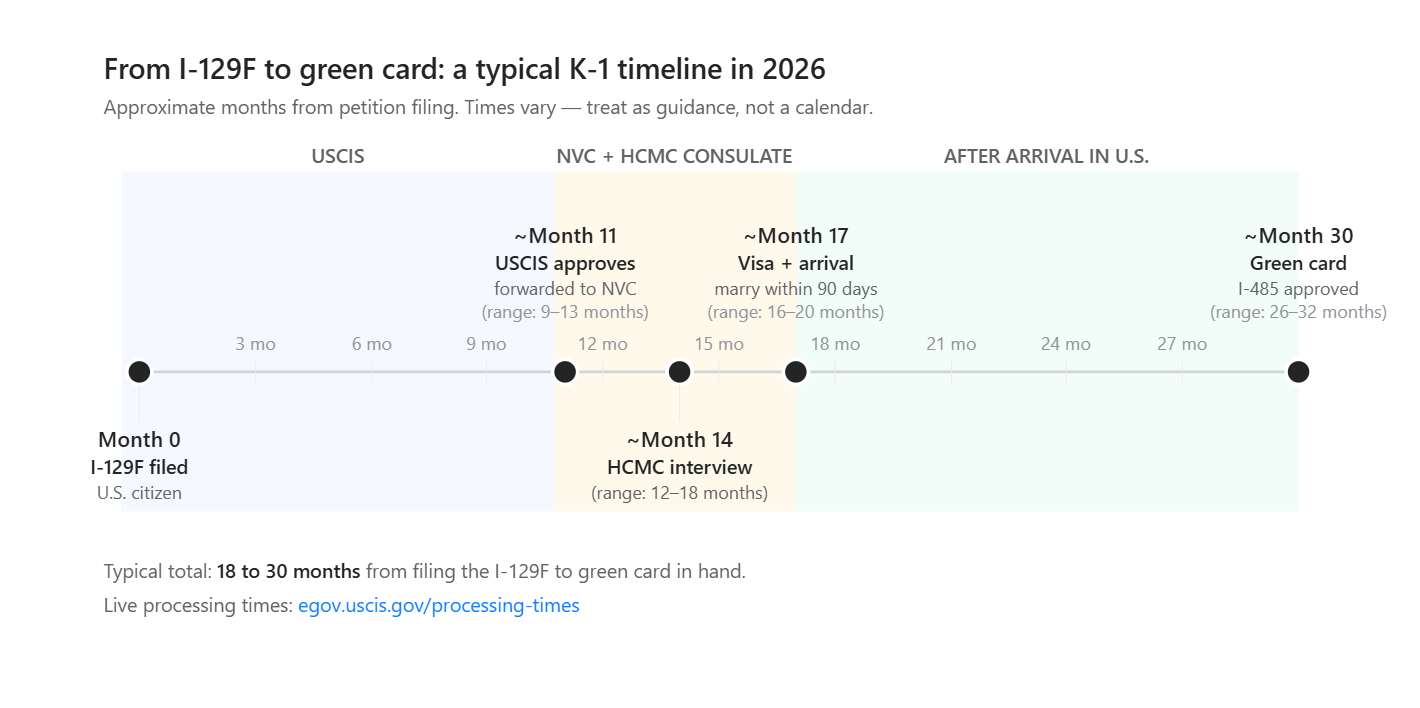
Once the I-129F is approved, the National Visa Center finishes its pre-processing in roughly 1 to 3 months, then transfers the file to the U.S. Consulate in Ho Chi Minh City. From there, your fiancée coordinates the medical exam in HCMC, and waits for an interview slot. The wait for the K-1 interview in Vietnam is typically 3 to 5 months depending on the season and case complexity. If the visa is issued and the fiancée enters the United States, the 90-day marriage window begins immediately, and Form I-485 (Adjustment of Status) is filed shortly after the wedding. The green card itself usually issues another 8 to 14 months later, depending on the service center.
The practical takeaway: don't plan weddings, leases, or job resignations around optimistic timelines. Build a buffer. Live processing-time data shifts throughout the year — always check the numbers at egov.uscis.gov/processing-times before committing to a specific date, and assume your case will land at the slower end of any range you're given.
Read this far and still have questions? You're not alone. Most couples preparing a K-1 case ask themselves the same things:
- Is our case strong or weak, what would an experienced reviewer see?
- If the rules on the government website read so simply, why are so many petitions still refused at the interview?
The right answers depend on facts that aren't in any guide: your meeting history, your travel plans, your income profile, your sponsor's tax record, your spouse's age and any compounding factors like a previous marriage or a long online-only stretch. The honest way forward is a candid, case-by-case review — not a checklist.
My team and I communicate fluently in both English and Vietnamese, so your spouse in the U.S. and your fiancée in Vietnam can each talk to us directly in the language they are most comfortable with — no interpreter, no translation back-and-forth, no second-hand summaries.
Ready to talk through your case? Send me a brief outline of your case and I will get back to you with the next steps that actually fit your situation. Use the form on the contact page to book an appointment at my office or message my Whatsapp directly. Initial case reviews are free.